Cloud, Assurance, Forensics, Engineering

Month: March 2026

RSAC is here….The $32B Signal: What the Google-Wiz Deal and the RSAC Sandbox Tell Us About Cyber’s Next Chapter

Last week the cybersecurity world shifted as Google’s $32 billion acquisition of Wiz officially closed. This marked the largest pure-play cyber deal in history. For those of us who have spent decades in the trenches, including my two tours as a CISO, this isn’t just a headline; it’s a validation of a massive structural shift in how we secure the modern enterprise.

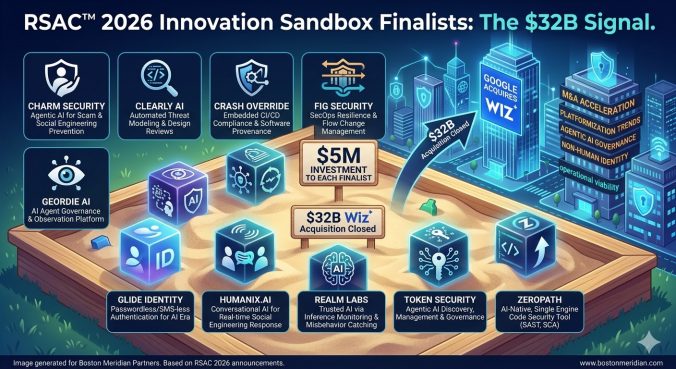
Interestingly, Wiz was an RSAC Innovation Sandbox finalist in 2021. While they didn’t win the “Most Innovative” trophy that year, they won the market. As we look toward the 2026 RSAC Innovation Sandbox next week, we aren’t just looking for “cool tech.” We are looking for the architectural blueprints of the next multi-billion-dollar exits.


The C-Suite & Founder Brief: 3 Themes Driving Value

After reviewing the 2026 Sandbox finalists and the broader market, three clear mandates have emerged for C-level executives and founders building for an exit:

1. The Governance of “Agentic” Autonomy

We have moved past simple LLM integration. The new frontier is Agentic AI: autonomous entities with their own identities, permissions, and the ability to execute code. Finalists like Token Security and Geordie AI are tackling the “identity crisis” of 2026 by governing non-human agents that can think and act. For the C-suite, this is a critical risk management hurdle; for founders, it’s the most lucrative “gap-fill” in the current identity stack.

2. From Education to Active Intervention

Social engineering remains the primary breach vector, but the “quarterly training” model has failed. We are seeing a shift toward Human Threat Detection and Response (HTDR). Companies like Humanix and Charm Security are using conversational AI to intervene during an attack. This transforms the “human layer” from a liability into a defensible endpoint.

3. The Death of the “Noise Machine” (Platformization)

Legacy SAST and SCA tools are being disrupted by AI-native engines. ZeroPath and Clearly AI are moving toward deep code understanding that identifies business logic flaws rather than just syntax errors.

Founders who can prove they are “replacing” 3–4 legacy tools with one AI-native platform are commanding the highest premiums. I hear from colleagues all the time: “We have too many tools and not enough people to work them.” The market is finally listening.


Investor’s Corner: The PE and VC Outlook

At Boston Meridian, we’re seeing a “K-shaped” recovery in cyber investment. While mid-market volumes remain selective, the appetite for “category-defining” platforms is at an all-time high.

The Upward Arm (The “Elite” Performers)

  • AI-Native Platforms: Companies like Wiz or the Innovation Sandbox finalists (e.g., Token Security, and ZeroPath) that solve “new world” problems like Agentic AI and Cloud Governance.
  • The Premium: These companies are seeing record-breaking valuations and oversubscribed funding rounds.
  • The Drivers: Strategic buyers (Google, Microsoft, and Palo Alto Networks) are willing to pay a massive “scarcity premium” for technologies that define a new category.

The Downward Arm (The “Legacy” or “Feature” Gap)

  • Point Solutions: Startups that offer a “feature” rather than a “platform” (e.g., just another basic phishing simulator or a legacy SAST scanner).
  • The Struggle: These companies are facing valuation resets and difficult “down-rounds.”
  • The Drivers: CISOs are consolidating “vendor sprawl.” If a tool doesn’t provide massive ROI or integrate into a larger ecosystem, it’s being cut from the budget.

Strategic Outlook

  • VC Perspective: The “SAFE” notes being issued to this year’s Sandbox finalists signal a return to aggressive early-stage backing. The focus has shifted from “AI-enabled” features to “AI-first” architectures. We expect agentic security rounds to be significantly oversubscribed heading into Q3.
  • PE & Strategic M&A: The Wiz deal proves the “Big 3” cloud providers and late-stage PE firms will pay for multicloud ubiquity. Buyers want “anchor” technologies that secure AWS, Azure, and OCI simultaneously.
  • The Valuation Gap: There is a growing premium for companies solving Identity and Data Posture Management (IDPM). As AI agents become the primary users of data, any company providing a “unified brain” for governance, seeing inside the AI’s thoughts during inference (as Realm Labs does), is a prime M&A target.

Connect with Us at RSAC 2026

The Google-Wiz closing has set a new high-water mark for the industry. If you are a founder navigating a capital raise or a C-suite executive looking to optimize your security spend against these new threats, let’s talk.

The Boston Meridian team will be on the ground in San Francisco all week. We have scaled our presence to three dedicated suites to accommodate the surge in deal-flow discussions.

The 2026 “Emerging Stars” Lookbook: Beyond the finalists, we are taking meetings for a curated lookbook of high-potential companies we’ve been tracking, innovators in identity, DSPM, and AI governance that haven’t hit the headlines yet.

Please reach out to us via our webpage and LinkedIn below.

www.bostonmeridian.com

Boston Meridian LinkedIn Page <- Follow this company!

About the Author:

I am Shawn Anderson, CTO and 2x former CISO, currently leading technical strategy at Boston Meridian. We are a boutique investment bank specializing in M&A and capital raises ($20m+) for the Cyber and Infrastructure sectors. Let’s connect on LinkedIn to discuss where the market is moving next.

Guardian Agents: The New Sovereignty in the “Agentic” Frontier

We have officially moved past the “chatbot” phase of artificial intelligence. In 2024, we experimented with LLMs as research assistants. In 2025, we piloted them as copilots. But as we move through 2026, we are entering the era of the Autonomous Agent. For those of us who have spent decades in the trenches of cybersecurity and investigations, this shift represents a fundamental change in the attack surface.

In my experience as a CTO and a two-time CISO, I’ve learned that security usually fails at the seams, the places where data moves from one trust zone to another. Agentic AI doesn’t just suggest text; it executes API calls, modifies code, and moves data independently. This means the failure modes have shifted from “hallucinations” to “unauthorized autonomous actions.”

The Evolution of the “Guardian Agent”

As we move into 2026, I’m seeing the market coalesce around a concept Gartner recently formalized as Guardian Agents. From my perspective as a practitioner, this isn’t just another layer of software; it represents a fundamental breakthrough in how we provide adaptable, intelligent oversight for autonomous systems.

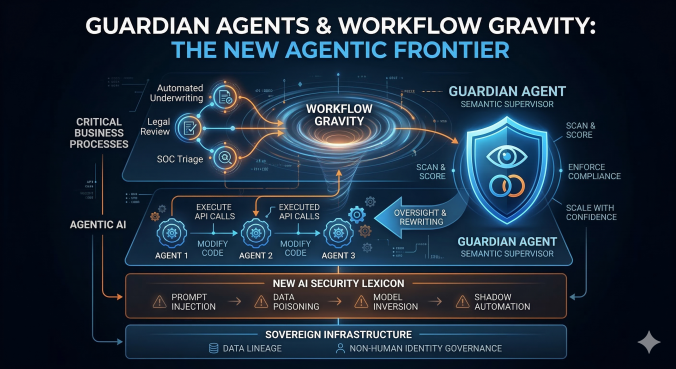
As defined in their recent February 2026 Market Guide, these agents are specialized AI systems designed specifically to monitor, oversee, and even rewrite the actions of other AI models. They aren’t just “detecting” problems; they are active participants in the workflow that ensure every output or action stays within the guardrails of the enterprise.

For a CISO, this is the “digital chain of custody.” It allows us to:

  • Scan and Score: Evaluating AI-generated content against brand voice and terminology in real-time.
  • Enforce Compliance: Automatically rewriting or blocking content that violates industry or regulatory standards.
  • Scale with Confidence: Moving AI out of the sandbox because we finally have a “Semantic Supervisor” that can catch a hallucination or an unauthorized API call before it causes damage.

The New AI Security Lexicon

To govern what you can’t see, you have to speak the language. The AI attack surface is now defined by concepts that didn’t exist in the C-suite playbook even three years ago.

  • Prompt Injection: Tricking a model into ignoring instructions. While direct injection is common, Indirect Injection is the silent killer. It occurs when an attacker hides instructions in a document or website that an agent “reads,” triggering an unauthorized action without the user’s knowledge.
  • Data Poisoning: The subtle manipulation of training data to create a “backdoor” in a model’s logic. This is a foundational compromise that standard security scans completely miss.
  • Model Inversion: An adversarial attack where someone queries an API repeatedly to reconstruct the sensitive data, like PII or trade secrets, used to train the model in the first place.
  • Shadow Automation: Much like the “Shadow IT” of a decade ago, this is the unauthorized wiring of AI agents into internal databases by employees looking for productivity shortcuts.

It’s All About the Data: The Reality of Workflow Gravity

The market is moving toward these technologies at a blistering pace because of a principle called “Workflow Gravity.

Workflow Gravity is the principle that once an AI agent is embedded into a critical business process (e.g., automated underwriting, legal review, or SOC triage), the “stickiness” of that platform becomes absolute.

In the SaaS era, we talked about data gravity with the idea that applications moved to where the data lived. In the agentic era, workflow gravity has taken over.

  • Defining the Pull: Workflow Gravity is the principle that once an AI agent is embedded into a critical business process like automated underwriting or SOC triage, the “stickiness” of that platform becomes absolute.
  • The M&A Catalyst: Security cannot be an afterthought in these scenarios; it must be native to the workflow. This is why consolidation is happening so fast. Major platforms are no longer just buying security tools; they are buying the data lineage and governance tools that allow them to “own” the customer’s most sensitive automated workflows.

Investors’ Corner: The VC and PE Alpha

For the investment community, the “Agentic” shift represents the most significant capital reallocation in a decade. We are moving away from “Point Solutions” and toward “Sovereign Infrastructure.”

The Valuation Gap: Pure-play code scanning is being commoditized. The premium is shifting to companies that provide Non-Human Identity Governance and Autonomous Policy Enforcement. If a startup can’t explain how they solve the “Semantic Intent” problem, their long-term defensibility is at risk.

The M&A Multiplier: We are seeing a “flight to platforms.” Private equity firms are increasingly looking for companies that don’t just secure the data but secure the action. The alpha is found in “Connective Tissue”, vendors that can provide a guardian layer across a multi-cloud, multi-agent environment.

Exit Strategy and Consolidation: As workflow gravity takes hold, the “Big Three” security platforms and global integrators are aggressively acquiring AI-TRiSM (Trust, Risk, and Security Management) startups. They aren’t just buying tech; they are buying the “Safety Switch” that allows their enterprise clients to move to production.

The Path Forward

The Guardian Agent is the first security tool in our history that understands intent. For leadership, this is the key to finally moving AI projects out of isolated sandboxes and into full production. Whether you are looking at Identity, Cloud Security, or Data Security, the message for 2026 is clear: you must secure the intent, or you will lose the workflow.


Please reach out to us via our webpage and LinkedIn below.

www.bostonmeridian.com

Boston Meridian LinkedIn Page <- Follow this company!

About the Author:

I am Shawn Anderson, CTO and 2x former CISO, currently leading technical strategy at Boston Meridian. We are a boutique investment bank specializing in M&A and capital raises ($20m+) for the Cyber and Infrastructure sectors. Let’s connect on LinkedIn to discuss where the market is moving next.
The “Claude Code” Correction: Why the SOC Isn’t Going Extinct

In February 2026, the markets reacted to Anthropic’s Claude Code Security as if it were a “black swan” event for cybersecurity. Stocks for the “Big Three,” CrowdStrike, Palo Alto, and Zscaler, took a significant hit. But as a former CISO, I can tell you: code remediation is only half the battle.

The Practitioner’s View: Vulnerability vs. Velocity

The market panic ignored a fundamental technical truth: Claude Code is a “pre-commit” evolution. It helps developers find and fix bugs faster than ever, effectively commoditizing portions of the Application Security and OSS Risk categories we track at Boston Meridian. However, as Gartner recently noted, these tools do not replace the operational infrastructure required to protect a live enterprise.

A tool that patches code cannot:

  • Manage Identity (H + NH) or prevent a session hijack in real-time.
  • Oversee Network Security or enforce ZTNA across hybrid clouds.
  • Provide the Cyber Asset Intelligence needed to understand your true “blast radius” during a breach.

For those of us managing complex enterprise stacks, the panic was a classic market overreaction. As mentioned, Claude Code is a formidable pre-commit tool that excels at identifying vulnerabilities within a codebase and suggesting immediate patches. It is a massive win for developer velocity, but it is not a replacement for an enterprise security platform.

The gap lies in runtime and infrastructure. While AI can harden an application during development, it cannot:

  • Replace Endpoint Detection and Response (EDR) or manage active threats in a live environment.
  • Orchestrate Zero Trust Network Access (ZTNA) across a global, hybrid workforce.
  • Provide the comprehensive governance and compliance monitoring required by highly regulated industries.

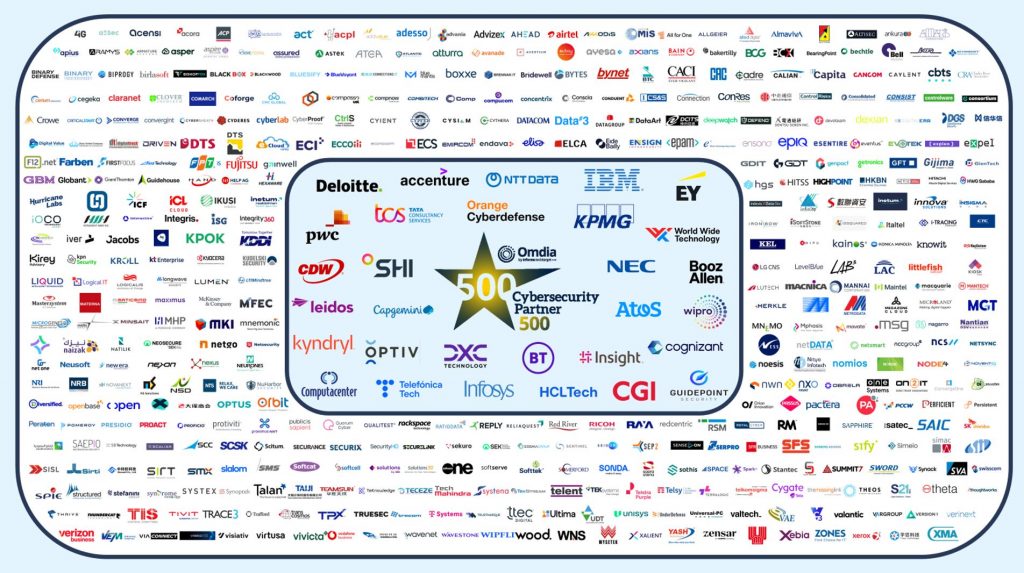
As the Omdia 500 landscape illustrates, the ecosystem of partners—from global integrators like Deloitte and Accenture to infrastructure giants like IBM and NTT Data, exists because security is an operational discipline, not just a coding one.

(8) Post | LinkedIn

Where it Fits: The Boston Meridian Market Map

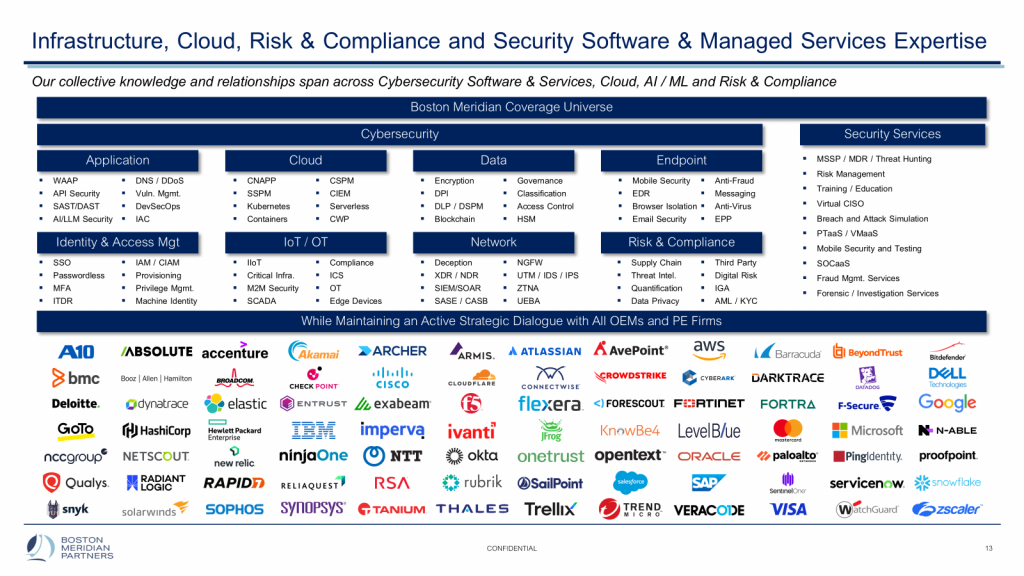
At Boston Meridian, we track the market across 9 critical domains. The “Claude” effect primarily touches Application Security. For CISOs and CIOs, the value here is in Security Enablement—using AI to reduce the “mean time to remediate.” But for the other 9 categories, from IoT/OT Security to Data Security, the need for robust, platform-centric defense has never been higher.

www.bostonmeridian.com – Mar 2026 – Market Map

Investor’s Corner: The PE & VC Outlook

  • The “Pure-Play” Squeeze: We are advising caution on standalone SAST/DAST vendors. As AI-native remediation becomes a feature of the IDE, these “point solutions” are prime targets for M&A or consolidation.
  • The Platform Resilience: The Omdia 500 confirms that the industry is built on service-heavy integrators and broad platforms. We see a massive opportunity for firms that can integrate AI-remediated telemetry into Managed Services (MSSP/MDR).
  • The Valuation Play: For startups looking to raise capital, we are looking for companies that don’t just “find” bugs but those that provide the Continuous Assurance and Evidence Automation that boards now demand.

Please reach out to us via our webpage and LinkedIn below.

www.bostonmeridian.com

Boston Meridian LinkedIn Page <- Follow this company!

About the Author:

I am Shawn Anderson, CTO and 2x former CISO, currently leading technical strategy at Boston Meridian. We are a boutique investment bank specializing in M&A and capital raises ($20m+) for the Cyber and Infrastructure sectors. Let’s connect on LinkedIn to discuss where the market is moving next.