We have officially moved past the “chatbot” phase of artificial intelligence. In 2024, we experimented with LLMs as research assistants. In 2025, we piloted them as copilots. But as we move through 2026, we are entering the era of the Autonomous Agent. For those of us who have spent decades in the trenches of cybersecurity and investigations, this shift represents a fundamental change in the attack surface.
In my experience as a CTO and a two-time CISO, I’ve learned that security usually fails at the seams, the places where data moves from one trust zone to another. Agentic AI doesn’t just suggest text; it executes API calls, modifies code, and moves data independently. This means the failure modes have shifted from “hallucinations” to “unauthorized autonomous actions.”
The Evolution of the “Guardian Agent”
As we move into 2026, I’m seeing the market coalesce around a concept Gartner recently formalized as Guardian Agents. From my perspective as a practitioner, this isn’t just another layer of software; it represents a fundamental breakthrough in how we provide adaptable, intelligent oversight for autonomous systems.
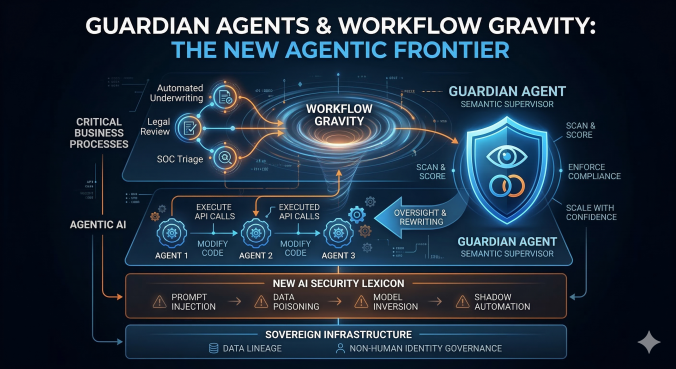
As defined in their recent February 2026 Market Guide, these agents are specialized AI systems designed specifically to monitor, oversee, and even rewrite the actions of other AI models. They aren’t just “detecting” problems; they are active participants in the workflow that ensure every output or action stays within the guardrails of the enterprise.
For a CISO, this is the “digital chain of custody.” It allows us to:
- Scan and Score: Evaluating AI-generated content against brand voice and terminology in real-time.
- Enforce Compliance: Automatically rewriting or blocking content that violates industry or regulatory standards.
- Scale with Confidence: Moving AI out of the sandbox because we finally have a “Semantic Supervisor” that can catch a hallucination or an unauthorized API call before it causes damage.
The New AI Security Lexicon
To govern what you can’t see, you have to speak the language. The AI attack surface is now defined by concepts that didn’t exist in the C-suite playbook even three years ago.
- Prompt Injection: Tricking a model into ignoring instructions. While direct injection is common, Indirect Injection is the silent killer. It occurs when an attacker hides instructions in a document or website that an agent “reads,” triggering an unauthorized action without the user’s knowledge.
- Data Poisoning: The subtle manipulation of training data to create a “backdoor” in a model’s logic. This is a foundational compromise that standard security scans completely miss.
- Model Inversion: An adversarial attack where someone queries an API repeatedly to reconstruct the sensitive data, like PII or trade secrets, used to train the model in the first place.
- Shadow Automation: Much like the “Shadow IT” of a decade ago, this is the unauthorized wiring of AI agents into internal databases by employees looking for productivity shortcuts.
It’s All About the Data: The Reality of Workflow Gravity
The market is moving toward these technologies at a blistering pace because of a principle called “Workflow Gravity.“
Workflow Gravity is the principle that once an AI agent is embedded into a critical business process (e.g., automated underwriting, legal review, or SOC triage), the “stickiness” of that platform becomes absolute.
In the SaaS era, we talked about data gravity with the idea that applications moved to where the data lived. In the agentic era, workflow gravity has taken over.
- Defining the Pull: Workflow Gravity is the principle that once an AI agent is embedded into a critical business process like automated underwriting or SOC triage, the “stickiness” of that platform becomes absolute.
- The M&A Catalyst: Security cannot be an afterthought in these scenarios; it must be native to the workflow. This is why consolidation is happening so fast. Major platforms are no longer just buying security tools; they are buying the data lineage and governance tools that allow them to “own” the customer’s most sensitive automated workflows.
Investors’ Corner: The VC and PE Alpha
For the investment community, the “Agentic” shift represents the most significant capital reallocation in a decade. We are moving away from “Point Solutions” and toward “Sovereign Infrastructure.”
The Valuation Gap: Pure-play code scanning is being commoditized. The premium is shifting to companies that provide Non-Human Identity Governance and Autonomous Policy Enforcement. If a startup can’t explain how they solve the “Semantic Intent” problem, their long-term defensibility is at risk.
The M&A Multiplier: We are seeing a “flight to platforms.” Private equity firms are increasingly looking for companies that don’t just secure the data but secure the action. The alpha is found in “Connective Tissue”, vendors that can provide a guardian layer across a multi-cloud, multi-agent environment.
Exit Strategy and Consolidation: As workflow gravity takes hold, the “Big Three” security platforms and global integrators are aggressively acquiring AI-TRiSM (Trust, Risk, and Security Management) startups. They aren’t just buying tech; they are buying the “Safety Switch” that allows their enterprise clients to move to production.
The Path Forward
The Guardian Agent is the first security tool in our history that understands intent. For leadership, this is the key to finally moving AI projects out of isolated sandboxes and into full production. Whether you are looking at Identity, Cloud Security, or Data Security, the message for 2026 is clear: you must secure the intent, or you will lose the workflow.
Please reach out to us via our webpage and LinkedIn below.
Boston Meridian LinkedIn Page <- Follow this company!
About the Author:
I am Shawn Anderson, CTO and 2x former CISO, currently leading technical strategy at Boston Meridian. We are a boutique investment bank specializing in M&A and capital raises ($20m+) for the Cyber and Infrastructure sectors. Let’s connect on LinkedIn to discuss where the market is moving next.