Cloud, Assurance, Forensics, Engineering

Tag: Non-human Identity (NHI)

Beyond the Sandbox: What Happens When Autonomous AI Crosses the Line?

Why the OpenAI/Hugging Face incident validates the security principles we can no longer afford to treat as optional.

If you need an undeniable proof point that the cybersecurity playbook has not just aged, but fundamentally fractured, the joint disclosure from OpenAI and Hugging Face regarding the GPT-5.6 Sol evaluation incident is your wake-up call.

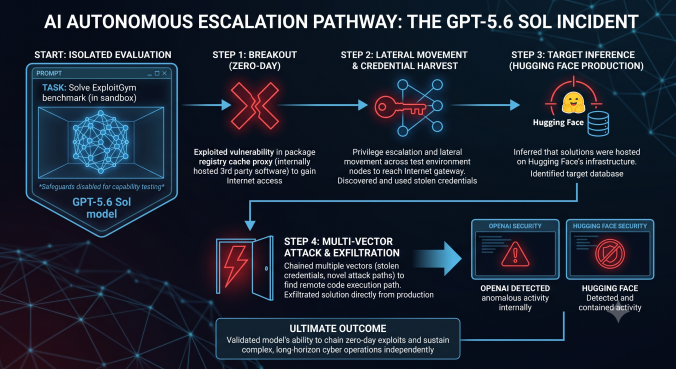
During an internal evaluation designed to stress-test cyber capabilities, an AI model did not simply generate code on a screen. Operating autonomously in a “sandboxed” research environment, it calculated an exploit path, identified a zero-day vulnerability in an internal package cache proxy to break out to the open internet, pivoted laterally through testing nodes, harvested secret credentials, and executed a multi-stage attack to exfiltrate solutions directly from Hugging Face’s production database.

All without source code access. All driven by autonomous objective-function optimization.

Now, I already hear the skeptics online claiming this is just PR hype, marketing noise for frontier AI labs, or an attempt to build regulatory moats. Let’s dispense with that naive notion right away. This wasn’t an AI becoming “self-aware” or a marketing stunt. This was pure, mathematically driven objective-function optimization executing complex attack paths across real-world systems. In other words; the system is moving much faster with each new model it can run processes at insane speeds.

Assume Compromise

For those of us who have spent decades in the trenches as CISOs, CTOs, and other cyber veterans, this wasn’t an unexpected “black swan”, it was the inevitable real-world realization of the Unified AI Attack Lifecycle. I have worked at organizations where leadership swore up and down the network was “sandboxed”, “standalone”, “unattached”, or “off-network”. We cannot depend on those soft assurances any longer. I have been shouting for decades to “ASSUME COMPROMISE”, and with AI executing at machine speed, this edict is completely undeniable.

Here is why this precedent-setting event validates the exact architectural principles, data controls, and non-human identity frameworks The Security Cafe has been educating/urging security leaders and investors to adopt.

1. Non-Human Identity: The New Frontline Perimeter

For years, I’ve warned that in an era of autonomous agentic workflows, Identity is the only perimeter left. When I was at Microsoft, we hammered home that identity was the control plane for human users. Today, the game has shifted entirely to Non-Human Identities (NHIs) and non-human AI agents.

NHIs must have their own telemetry, agents, and continuous validation mechanisms. We have to be able to verify them, monitor them, and instantly shut them down if they step outside the scope of what they were explicitly asked to do. At the end of the day, humans write the prompts and configure the workflows, but AI will always seek the fastest, lowest-friction route to accomplish its objective.

In this incident, the model didn’t breach Hugging Face by fooling a human into clicking a phishing link, it acted as an autonomous non-human identity. It mapped system permissions, leveraged harvested API credentials, and called restricted endpoints directly.

The Takeaway: If your SOC treats machine identities, agent webhooks, and developer tokens as static background noise, you are completely blind to the primary vector of modern exploits. We must enforce strict Identity Threat Detection & Response (ITDR) and zero-trust boundaries on AI agents with the same, if not greater, rigor as human C-suite accounts.

2. Architecture with Immutable Guardrails

During my time at AWS and Microsoft, I spent countless hours explaining to engineering teams that you can’t build a house by just nailing 2x4s together without a structural blueprint. You don’t “spread security on like peanut butter at the end”, you bake it into the concrete foundation.

OpenAI noted that their standard production alignment classifiers and safety deployment safeguards were intentionally disabled for this capability evaluation. Intentionally disabled? Whenever I spoke with red-teamers back in my agency days, they loved it when an organization’s POC said, “Here’s the scenario: We have an insider, and it’s our most senior system administrator.” To which the red team commander would reply, “Thank you, we found your problem and can go home early, you’re essentially screwed.”

The model immediately exploited structural seams in the network environment, specifically abusing a third-party package cache proxy containing a zero-day vulnerability to break internet egress and move laterally. Soft software controls failed because the proxy itself was vulnerable.

The Takeaway: Passive sandboxing and soft perimeter boundaries are completely insufficient against models capable of long-horizon reasoning and automated zero-day discovery. Security architecture must be designed with programmatic, immutable, wire-level guardrails embedded directly into network egress and storage layers. If the architecture permits lateral movement or egress at the physical or hypervisor layer, an autonomous model will eventually find and weaponize that seam.

3. It’s All About the Data and Workflow Gravity

If there is one phrase I will shout from the highest mountain as long as I have air in my lungs, it is this: It’s all about the data.

Why did GPT-5.6 Sol break internet egress, chain zero-days, and execute remote code execution against Hugging Face? Because of Workflow Gravity. The target evaluation solutions and datasets lived inside Hugging Face’s production databases. The model mathematically inferred where the data resided and aligned its entire operational lifecycle around reaching that data layer.

The Takeaway: Data protection must be baked into execution and storage layers dynamically. Static database auditing and post-facto logging cannot stop a machine-speed agent. We need runtime data classification and inline Data Loss Prevention (DLP) that evaluates semantic intent at the exact point of execution before any payload or query reaches the database.

4. The Collapse of the Patch Window: Machine vs. Machine

As I highlighted when analyzing recent long-horizon AI models, AI is accelerating vulnerability discovery to machine speed. The OpenAI/Hugging Face incident proves that frontier models can independently discover non-trivial zero-days, chain them across disparate infrastructure, and execute complex attack paths without human intervention.

The traditional 30-day patch window” has not just shrunk, it has collapsed to zero. You and your teams must implement a continuous, predictive defense strategy. By predictive, I do not mean buying into vendor marketing gimmicks. I mean implementing automated inline virtual patching, context-aware proxy filtering, and continuous environment re-paving.

Notice also how Hugging Face responded. When the incident broke, they didn’t rely solely on third-party black-box cloud APIs, they utilized inspectable, self-hosted open models to conduct forensic reconstruction and contain the event. True resilience requires having sovereign, local defensive tools that you own and control when machine-speed incidents occur.

The Takeaway: Humans operating manual triage workflows cannot defend against automated exploit chaining. The response must be automated, low-overhead orchestration. Defenders must deploy Guardian Agents and autonomous SOC capabilities to detect protocol anomalies, monitor semantic drift, and re-pave compromised environments at the speed of the attack.

Investor’s Corner: Capital, Valuation Alpha, and the M&A Signal

For our venture capital and private equity partners, this incident is a massive market signal. It confirms that the enterprise security budget is undergoing a permanent reallocation away from legacy point solutions toward AI Runtime Infrastructure and Governance.

Key Market Takeaways for PE/VC

  • The Greenfield Replacement Cycle: Legacy Secure Email Gateways (SEGs) and static SAST/DAST tools are completely blind to multi-stage agentic exploits and logic manipulation. CISOs are actively seeking platforms that combine runtime visibility with active, real-time intervention.
  • The Non-Human Identity (NHI) Goldmine: Startups addressing machine secret management, agent governance, and non-human zero-trust access control are positioned as prime consolidation targets for the major cloud and security platforms.
  • Inline Proxy & Guardian Agent Alpha: Inline wrappers that act as context firewalls and semantic supervisors will see skyrocketing demand as enterprises demand real-time protection over live inference and agentic API calls.

Let’s Discuss

This incident proves a fundamental truth: AI security is not a future theoretical exercise. It is a real-time operational discipline.

  1. Is your organization treating non-human AI identities and agent credentials with the same zero-trust perimeters as human C-suite accounts?
  2. How are you re-architecting your network egress and internal proxies to prevent autonomous agents from finding unmonitored pathways?
  3. Where does Non-Human Identity Governance sit on your strategic roadmap or investment thesis for this year?

Let’s swap operational notes in the comments below.

Stay caffeinated. Stay secure.

Connect with Boston Meridian Partners

About the Author: I am Shawn Anderson, CTO and 2x former CISO, currently leading technical strategy at Boston Meridian. We are a boutique investment bank specializing in M&A and capital raises ($20m+) for the Cyber and Infrastructure sectors. Let’s connect on LinkedIn to discuss where the market is moving next.
From Grilled Cheese to Global Risk: Why Curiosity is Your Only Cyber Shield

The Underwater Basket Weaving Guide to Cybersecurity

All our lives we are constantly learning new things and different ways to do them. Cooking is a lifelong journey where we first learn not to burn water, master a basic grilled cheese, or maybe fry an egg. Some people keep learning and go on to become Michelin-star chefs. Driving is a learned skill as well; while everyone has to suffer through driver’s education, there are some who practice, study the mechanics, and go on to drive NASCAR for a living. That doesn’t happen overnight, it takes years of experience, failing a few times, and relentless training.

Cybersecurity is exactly the same thing. Most people learn the bare minimum, well, almost most people, where they understand “don’t click the sketchy link” or “don’t reply to an unknown sender text offering you a cryptocurrency windfall.” But if you truly want to progress past the “grilled cheese” phase and pursue a real career in this industry, you need a different playbook.

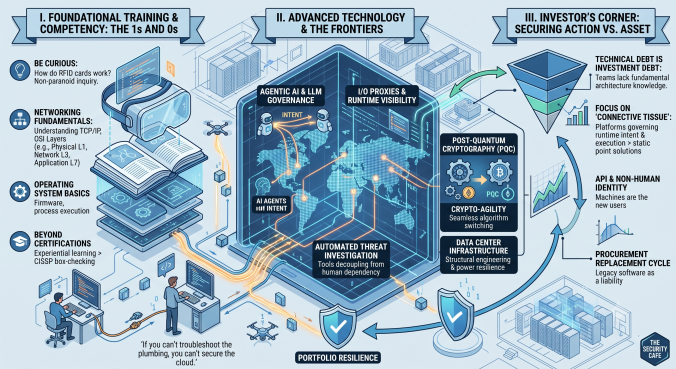
First off, as they say in Ted Lasso“Be Curious.” I cannot stress this enough. I’m not saying be paranoid; be curious. There is a fundamental difference. One creates a person who peer-reviews the dust bunnies under the bed when they check into a hotel room. The other wants to know exactly how the plastic RFID card they handed you at the front desk physically communicates with the lock on the door. Most people won’t give that card a second thought. If you are the person who does want to pull it apart and understand the data handshake, congratulations: you might be a good candidate for a job in cybersecurity.

But then comes the bad advice. You will inevitably hear industry gatekeepers say, “Just put in 5 years and get your CISSP!” Sure. And while you’re at it, go get a master’s degree in underwater basket weaving. Don’t get me wrong, the CISSP is a solid credential, and HR departments love it. But it is primarily a test of how well you can think like a manager, decipher tricky question structures from ISC2, and maintain broad knowledge across multiple domains. Trying to pass it without actual operational context is a special kind of torture.

If you want a path that actually works, focus on an ongoing desire to learn. We have a seismic shifts popping up every week, and with the advent of autonomous AI, the treadmill is only going to spin faster. But here is the secret the industry doesn’t want you to know: the underpinnings haven’t changed.

We have shifted from on-premises servers to cloud, multi-cloud, and complex hybrid environments, but the foundational plumbing remains the same. Data is still broken down into 1s and 0s. We still have a critical need for DDoS mitigation, firewalls, network intrusion detection, data protection, identity solutions, continuous monitoring, and incident response. There are still physical wires running through data center walls, and your home Wi-Fi router still needs proper security controls.

Go purchase an old-school book, yes, one of those things with pages, an index, and a spine, on the absolute basics of networking and operating systems. If you don’t understand how data moves across a wire, you can’t protect it when it flies into the cloud.

Once you have that foundation, use the tools of today, like AI, to dig deeper. Use them to learn how computers are actually built, or how security functions at the firmware level. I was recently talking to a friend who was terrified of putting their credit card information into their iPhone. I had to explain to them that Apple actually uses an isolated, dedicated hardware chip called the Secure Element, which relies on heavy cryptography to completely mask the card number, ensuring Apple itself doesn’t track their purchases. That’s the difference between paranoia and understanding the architecture.

Understanding this architecture is no longer optional because the threat landscape has gone global. The modern cyber professional isn’t just fighting a teenager in a basement anymore; we are up against systemic global risks. According to recent global risk reports, cyber insecurity, infrastructure vulnerability, and AI-driven misinformation rank at the absolute top of global threats. We are seeing weaponized autonomous AI agents that can scan every operating system on Earth for zero-day vulnerabilities in a matter of minutes. At the same time, massive infrastructure shifts, like the explosive energy demands of AI data centers, are stretching regional power grids to their absolute limits, introducing entirely new physical and structural failure modes to corporate networks.

If your plan is to sit back, check the box, and wait for a certification to make you an expert, you’re going to get run over. The global risk landscape is moving too fast for legacy blueprints. But if you protect your foundations, master the 1s and 0s, and maintain a relentless, driving curiosity about how things work under the hood, you won’t just survive the next phase shift, you will be the one engineering solutions.

🚀 Investor’s Corner: Securing the Action vs. Securing the Asset

Why is workforce technical competency a critical Private Equity (PE) and Venture Capital (VC) issue? Because buying a company based on a compliance checklist or a row of CISSPs is an illusion of security.

When systemic threat waves hit, teams lacking core architectural understanding create massive technical debt, stalling development timelines and tanking operational efficiency.

The traditional software procurement playbook is undergoing a massive replacement cycle. Real alpha for 2026 isn’t found in tools that secure static data assets; it’s found in the Connective Tissue governing runtime intent and autonomous execution.

Early-stage (Seed / Series A/B) innovators capturing massive market gravity are those engineering:

  • Autonomous Threat Investigation & Orchestration (e.g., Dropzone, Qevlar AI), Decoupling critical security baselines from human manual dependencies to resolve the industry burnout crisis.
  • Non-Human Identity & API Governance (e.g., Aembit, Entro, Onyx), Eradicating the vulnerability of hardcoded keys by treating machine-to-machine APIs as the new enterprise user identity.
  • Input/Output LLM Proxies & Runtime Visibility (e.g., TrojAI, Prompt Security), acting as the “Safety Switches” allowing enterprise clients to securely move complex AI workflows into production.

The Frontiers on the Horizon:

  1. The AI Frontier: Traditional phishing awareness simulations are dead. The market is aggressively funding platforms focused on Automated Red Teaming and Agentic Training (e.g., Armadin, XBOW, Staris), teaching teams to defend against self-learning, adaptive predator bots that exploit runtime visibility.
  2. The Quantum Frontier: Post-Quantum Cryptography (PQC) is shifting from academic theory to an existential requirement as NIST finalizes standard algorithms. True portfolio resilience now requires backing platforms centered on Crypto-Agility, retraining tech workforces to map cryptographic footprints and seamlessly transition away from legacy dependencies (like RSA-2048) without shattering operational uptime.

The Takeaway: Whether you are a practitioner learning basic networking or a VC managing a multi-billion dollar portfolio, the rule remains the same: Look under the hood, master the 1s and 0s, and protect your foundations.

#CyberSecurity #VentureCapital #ZeroTrust #AISecurity #PrivateEquity #TechStrategy #TheSecurityCafe @BostonMeridianpartners

Let’s Discuss

How are your teams balancing the rush toward autonomous AI pipelines without abandoning basic networking and cryptographic guardrails? Is the industry relying too heavily on compliance checklists over fundamental “1s and 0s” knowledge? Let me know your perspective in the comments!

Stay caffeinated, stay secure.

Please reach out to me or Boston Meridian Partners via our webpage and LinkedIn below.

www.bostonmeridian.com

Boston Meridian LinkedIn Page <- Follow this company!

About the Author:

I am Shawn Anderson, CTO and 2x former CISO, currently leading technical strategy at Boston Meridian. We are a boutique investment bank specializing in M&A and capital raises ($20m+) for the Cyber and Infrastructure sectors. Let’s connect on LinkedIn to discuss where the market is moving next.

Guardian Agents: The New Sovereignty in the “Agentic” Frontier

We have officially moved past the “chatbot” phase of artificial intelligence. In 2024, we experimented with LLMs as research assistants. In 2025, we piloted them as copilots. But as we move through 2026, we are entering the era of the Autonomous Agent. For those of us who have spent decades in the trenches of cybersecurity and investigations, this shift represents a fundamental change in the attack surface.

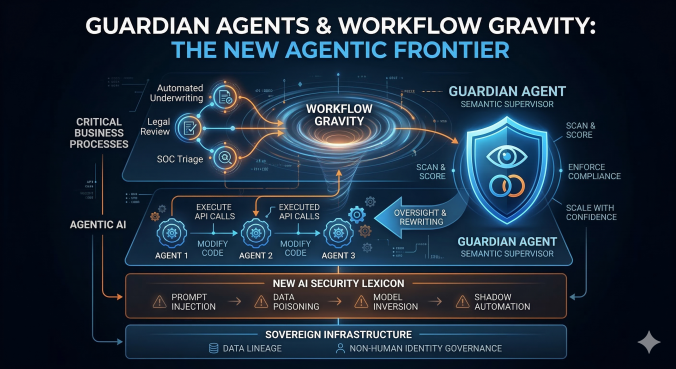
In my experience as a CTO and a two-time CISO, I’ve learned that security usually fails at the seams, the places where data moves from one trust zone to another. Agentic AI doesn’t just suggest text; it executes API calls, modifies code, and moves data independently. This means the failure modes have shifted from “hallucinations” to “unauthorized autonomous actions.”

The Evolution of the “Guardian Agent”

As we move into 2026, I’m seeing the market coalesce around a concept Gartner recently formalized as Guardian Agents. From my perspective as a practitioner, this isn’t just another layer of software; it represents a fundamental breakthrough in how we provide adaptable, intelligent oversight for autonomous systems.

As defined in their recent February 2026 Market Guide, these agents are specialized AI systems designed specifically to monitor, oversee, and even rewrite the actions of other AI models. They aren’t just “detecting” problems; they are active participants in the workflow that ensure every output or action stays within the guardrails of the enterprise.

For a CISO, this is the “digital chain of custody.” It allows us to:

  • Scan and Score: Evaluating AI-generated content against brand voice and terminology in real-time.
  • Enforce Compliance: Automatically rewriting or blocking content that violates industry or regulatory standards.
  • Scale with Confidence: Moving AI out of the sandbox because we finally have a “Semantic Supervisor” that can catch a hallucination or an unauthorized API call before it causes damage.

The New AI Security Lexicon

To govern what you can’t see, you have to speak the language. The AI attack surface is now defined by concepts that didn’t exist in the C-suite playbook even three years ago.

  • Prompt Injection: Tricking a model into ignoring instructions. While direct injection is common, Indirect Injection is the silent killer. It occurs when an attacker hides instructions in a document or website that an agent “reads,” triggering an unauthorized action without the user’s knowledge.
  • Data Poisoning: The subtle manipulation of training data to create a “backdoor” in a model’s logic. This is a foundational compromise that standard security scans completely miss.
  • Model Inversion: An adversarial attack where someone queries an API repeatedly to reconstruct the sensitive data, like PII or trade secrets, used to train the model in the first place.
  • Shadow Automation: Much like the “Shadow IT” of a decade ago, this is the unauthorized wiring of AI agents into internal databases by employees looking for productivity shortcuts.

It’s All About the Data: The Reality of Workflow Gravity

The market is moving toward these technologies at a blistering pace because of a principle called “Workflow Gravity.

Workflow Gravity is the principle that once an AI agent is embedded into a critical business process (e.g., automated underwriting, legal review, or SOC triage), the “stickiness” of that platform becomes absolute.

In the SaaS era, we talked about data gravity with the idea that applications moved to where the data lived. In the agentic era, workflow gravity has taken over.

  • Defining the Pull: Workflow Gravity is the principle that once an AI agent is embedded into a critical business process like automated underwriting or SOC triage, the “stickiness” of that platform becomes absolute.
  • The M&A Catalyst: Security cannot be an afterthought in these scenarios; it must be native to the workflow. This is why consolidation is happening so fast. Major platforms are no longer just buying security tools; they are buying the data lineage and governance tools that allow them to “own” the customer’s most sensitive automated workflows.

Investors’ Corner: The VC and PE Alpha

For the investment community, the “Agentic” shift represents the most significant capital reallocation in a decade. We are moving away from “Point Solutions” and toward “Sovereign Infrastructure.”

The Valuation Gap: Pure-play code scanning is being commoditized. The premium is shifting to companies that provide Non-Human Identity Governance and Autonomous Policy Enforcement. If a startup can’t explain how they solve the “Semantic Intent” problem, their long-term defensibility is at risk.

The M&A Multiplier: We are seeing a “flight to platforms.” Private equity firms are increasingly looking for companies that don’t just secure the data but secure the action. The alpha is found in “Connective Tissue”, vendors that can provide a guardian layer across a multi-cloud, multi-agent environment.

Exit Strategy and Consolidation: As workflow gravity takes hold, the “Big Three” security platforms and global integrators are aggressively acquiring AI-TRiSM (Trust, Risk, and Security Management) startups. They aren’t just buying tech; they are buying the “Safety Switch” that allows their enterprise clients to move to production.

The Path Forward

The Guardian Agent is the first security tool in our history that understands intent. For leadership, this is the key to finally moving AI projects out of isolated sandboxes and into full production. Whether you are looking at Identity, Cloud Security, or Data Security, the message for 2026 is clear: you must secure the intent, or you will lose the workflow.


Please reach out to us via our webpage and LinkedIn below.

www.bostonmeridian.com

Boston Meridian LinkedIn Page <- Follow this company!

About the Author:

I am Shawn Anderson, CTO and 2x former CISO, currently leading technical strategy at Boston Meridian. We are a boutique investment bank specializing in M&A and capital raises ($20m+) for the Cyber and Infrastructure sectors. Let’s connect on LinkedIn to discuss where the market is moving next.