The chain of change…
If you’ve been keeping up with our discussions here at The Security Cafe, or tracking the rapid evolution of enterprise pipelines, you already know one thing to be true: The traditional security playbook hasn’t just aged; it has fundamentally fractured. When we talk about the attack lifecycle, a concept pioneered conceptually by Lockheed Martin years ago, we used to picture binaries, command-and-control (C2) servers, and standard lateral movement across Windows subnets. But as enterprise workflows increasingly adopt Agentic AI, large language models, and automated data ingestion pipelines, the threat landscape has undergone a permanent phase shift. While you still need to understand what is coming in, through, and out of your environment the challenge is a multitude faster with the creation of AI.
Adversaries haven’t abandoned their old entry points; instead, they are using traditional delivery mechanisms to pull off entirely new, logic-based exploits. I have been in the trenches more times than I care to count. At the end of the day, we need to understand there are numerous ways the adversary (both in and out of the organization) will attack us.
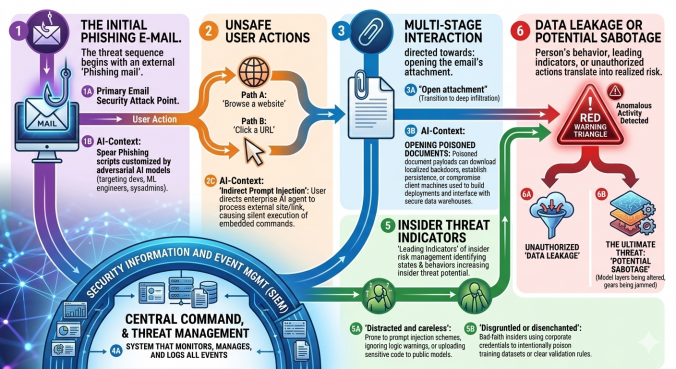
To help visualize the problems in an AI world, I have mapped out a 6-Stage Unified AI Attack Lifecycle. It connects the foundational attack surfaces we manage every single day, Email Security, User Behavioral Risk, and Insider Threat Management, directly to the structural vulnerabilities of modern machine learning setups.
Here is exactly how an attack flows through this loop, and why your standard defense parameters might be missing the signal.
Step 1: The Initial Phishing E-mail (AI-Scaffolded Engineering)
The sequence begins exactly where the vast majority of enterprise breaches do: an external Phishing Mail. However, the AI context changes the sophistication of this initial delivery. Adversaries are now utilizing advanced offensive models to analyze public executive footprints and automatically write highly targeted, hyper-personalized spear-phishing scripts. They aren’t just aiming for low-level credentials anymore; they are explicitly targeting developers, ML engineers, and data system administrators who hold the keys to core production models.
Step 2: Unsafe User Actions (The Ingestion Trap)
Once the email hits the inbox, the attack chain splits based on user behavior: they might Browse a Website or Click a URL. In a traditional framework, this triggers a web exploit kit or a credential harvesting page.
In the modern enterprise AI context, this is where Indirect Prompt Injection thrives. If a user unknowingly directs an active, automated enterprise AI agent to process, read, or summarize the contents of that external web page, the hidden instructions embedded within the page take control. The AI agent silenty hijacks its own system instructions, executing unauthorized commands completely behind the scenes.
Step 3: Multi-Stage Interaction (Poisoned Attachments)
If the user follows the more direct path of opening a document asset via the “Open attachment” paperclip trigger, the attack transitions from perimeter email security straight into deep infiltration.
When a developer or data scientist opens a poisoned document on a client machine used to manage data warehouses or build model deployments, the adversary establishes localized persistence. By compromising the workspace of the staff building the models, the attacker gains direct, authenticated access upstream, bypassing the standard defenses guarding your core training data.
Step 4: Central Command, Monitoring, and Threat Management (The SIEM Anchor)
Running horizontally as a foundational arch beneath this entire exploitation sequence is your Security Information and Event Management (SIEM) environment. As I always stress to fellow security leaders, you have to treat your security posture like a blueprint where you can visualize the electrical, plumbing, and network routing simultaneously. Makes me miss the days of using Autocad.
The SIEM is your unified visibility layer. It is the core command structure responsible for logging, tracking, and cross-referencing events across the entire loop—ensuring that an anomalous outbound API call from an AI agent can be structurally correlated with an early phishing alert or an unusual endpoint interaction. There are a number of new startups who are working to bring the AI SOC to customers using pure automation. I list some of these at the end of this newsletter.
Step 5: Insider Threat Indicators (The Psychology of Risk)
Security isn’t just a technical challenge; it’s deeply behavioral. Below the main operational flow, we must constantly account for leading indicators of insider risk, which generally cluster into two core psychological profiles:
- The Distracted and Careless: Well-meaning employees who are prone to pasting proprietary source code or highly confidential PII into unmonitored public models for quick productivity shortcuts, creating immediate exposure.
- The Disgruntled or Disenchanted: Malicious or coerced insiders who actively abuse their authentic system credentials to bypass safety logic, clear code-validation rules, or deliberately introduce bias and backdoors directly into corporate fine-tuning training datasets.
Step 6: Data Leakage or Potential Sabotage (The Realized Event)
When these behavioral anomalies or unauthorized external actions go undetected, they culminate in a high-impact security event, marked by the Red Warning Triangle. In the machine learning era, this damage is divided into two distinct corporate impacts:
- Unauthorized Data Leakage: High-volume extraction of confidential corporate data assets, intellectual property, or proprietary training weights via reverse-engineering or unmonitored model endpoints.
- Potential Sabotage: The ultimate structural threat. The adversary successfully manipulates data pipelines, altering model layers and logic structures until the core predictive system is completely corrupted or operational workflows are entirely locked down.
The CISO’s Mandate: How to Use This Framework
As security professionals, our immediate assignment is simple: Do not try to boil the ocean. You don’t need to rebuild your security program from scratch to survive the AI era; you need to map your current tools and telemetry directly over this operational loop.
Take your existing Secure Email Gateways, your insider behavioral logging, your web content filters, and your SIEM rules, and overlay them onto these six phases. Look honestly for the blind spots. Where do you have great telemetry, and where are you completely blind to how data traverses your AI endpoints?
Once you document those structural gaps, you can build a realistic, risk-adjusted roadmap to defend the enterprise.
☕ Investor’s Corner: Capital, Churn, and the New Guard
As an advisor and CTO closely tracking technology deal flow, I am watching an aggressive reallocation of capital toward startups addressing structural gaps in the Unified AI Attack Lifecycle. Traditional endpoint and perimeter plays are heavily commoditized; the real valuation alpha right now is concentrated where machine learning pipelines meet autonomous execution.
If you are evaluating early-stage security bets or looking at infrastructure consolidation trends, here is what is happening across the market:
🚀 Early-Stage Startups to Watch (Seed / Series A)
We are tracking a wave of nimble, highly specialized entities built specifically to break the attacker’s progression along this modern lifecycle. A quick note before diving in: the following list isn’t an official endorsement, but rather a curated sampling of early-stage innovators that security leaders should actively monitor, evaluate, and engage with as they map out their defense roadmap.
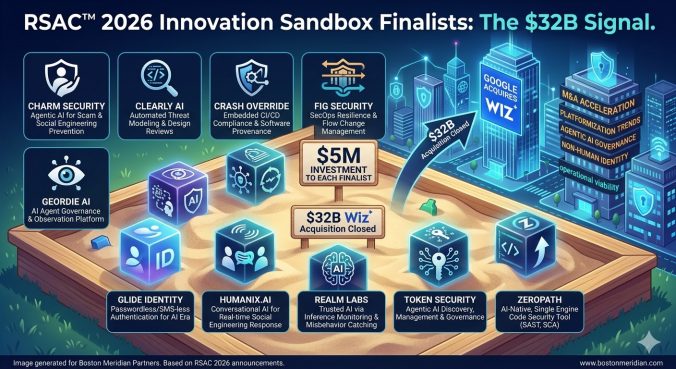
- The Vulnerability Test Layer (Phase 1/2): Companies like Armadin Security, XBOW, and Staris AI are capturing venture interest by shifting from manual testing to autonomous, AI-driven red-teaming capable of identifying deep logical flaws before offensive LLMs exploit them.
- The Gateway & Proxy Layer (Phase 2/3): Startups including TrojAI, Prompt Security, and Lakera are establishing an early foothold as inline wrappers. They act as “firewalls for context strings,” sanitizing payloads to prevent indirect prompt injection.
- The Non-Human Identity Layer (Phase 4/5): Solutions such as Onyx Security, Aembit, and Entro Security are solving the massive governance challenge of “Shadow Automation.” They manage privileges for automated worker agents, machine keys, and webhooks that outnumber human accounts in the enterprise.
- The Autonomous SOC Layer (Phase 4/6): As telemetry volume explodes, Qevlar AI, 7AI, Crogl, and Dropzone AI are attracting late-Seed and Series A capital by engineering autonomous AI analysts capable of cross-correlating system alerts at machine speeds.
🎯 Key Market Drivers
- The Fallacy of the Legacy Tech Stack: Traditional Secure Email Gateways (SEGs) and standard SIEM rules are structurally blind to linguistic manipulation. Legacy platforms cannot identify semantic anomalies like indirect prompt injection or tensor dataset poisoning. This has created a massive greenfield replacement cycle for enterprise procurement.
- The “Agentic” Explosion: Organizations aren’t just using chat interfaces anymore; they are spinning up autonomous scripts and system integrations with live API read/write privileges. Securing non-human worker identities is the fastest-growing pain point for modern enterprise infrastructure.
- Training vs. Inference Infrastructure Costs: As market demand swings heavily toward inference (the actual operational queries hits on deployed models), security must move inline. Leaders are prioritizing high-throughput, low-latency security proxies that won’t choke data center capacities.
📈 What We Are Seeing in the Markets
We are seeing an intense amount of activity in the early rounds (Seed through Series A), driven by strategic venture arms (like CrowdStrike Falcon Fund and Okta Ventures) eager to co-invest alongside tier-1 institutional funds. Corporate buyers are hunting for immediate, plug-and-play architectural solutions.
The Takeaway for Private Capital: The standard cybersecurity playbook is fractured. The startups that can successfully integrate with existing data frameworks, prove they don’t break latency limits, and secure non-human automation parameters are commanding premium valuations and positioning themselves as prime consolidation targets over the next 18 to 24 months.
Let’s talk in the comments: How is your security organization adjusting to the risk of indirect prompt injection and shadow automation? Are you treating your AI agent identities with the same stringent perimeters as human accounts? What early-stage AI security vectors are currently sitting on your investment thesis for this year?
#CyberSecurity #CISO #AI #MachineLearning #InsiderRisk #TheSecurityCafe #ThreatModeling
Let’s Discuss
Is “Security by Design” still a pipe dream, or are we finally ready to architect with the assumption that the AI has already found the door?
Stay caffeinated, stay secure.
Please reach out to me or Boston Meridian Partners via our webpage and LinkedIn below.
Boston Meridian LinkedIn Page <- Follow this company!
About the Author:
I am Shawn Anderson, CTO and 2x former CISO, currently leading technical strategy at Boston Meridian. We are a boutique investment bank specializing in M&A and capital raises ($20m+) for the Cyber and Infrastructure sectors. Let’s connect on LinkedIn to discuss where the market is moving next.