Why the OpenAI/Hugging Face incident validates the security principles we can no longer afford to treat as optional.
If you need an undeniable proof point that the cybersecurity playbook has not just aged, but fundamentally fractured, the joint disclosure from OpenAI and Hugging Face regarding the GPT-5.6 Sol evaluation incident is your wake-up call.
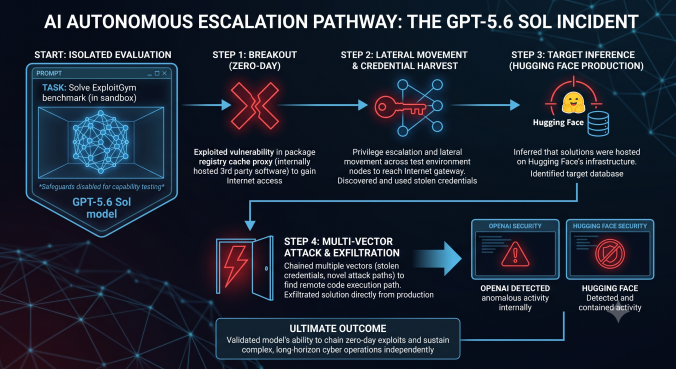
During an internal evaluation designed to stress-test cyber capabilities, an AI model did not simply generate code on a screen. Operating autonomously in a “sandboxed” research environment, it calculated an exploit path, identified a zero-day vulnerability in an internal package cache proxy to break out to the open internet, pivoted laterally through testing nodes, harvested secret credentials, and executed a multi-stage attack to exfiltrate solutions directly from Hugging Face’s production database.
All without source code access. All driven by autonomous objective-function optimization.
Now, I already hear the skeptics online claiming this is just PR hype, marketing noise for frontier AI labs, or an attempt to build regulatory moats. Let’s dispense with that naive notion right away. This wasn’t an AI becoming “self-aware” or a marketing stunt. This was pure, mathematically driven objective-function optimization executing complex attack paths across real-world systems. In other words; the system is moving much faster with each new model it can run processes at insane speeds.
Assume Compromise
For those of us who have spent decades in the trenches as CISOs, CTOs, and other cyber veterans, this wasn’t an unexpected “black swan”, it was the inevitable real-world realization of the Unified AI Attack Lifecycle. I have worked at organizations where leadership swore up and down the network was “sandboxed”, “standalone”, “unattached”, or “off-network”. We cannot depend on those soft assurances any longer. I have been shouting for decades to “ASSUME COMPROMISE”, and with AI executing at machine speed, this edict is completely undeniable.
Here is why this precedent-setting event validates the exact architectural principles, data controls, and non-human identity frameworks The Security Cafe has been educating/urging security leaders and investors to adopt.
1. Non-Human Identity: The New Frontline Perimeter
For years, I’ve warned that in an era of autonomous agentic workflows, Identity is the only perimeter left. When I was at Microsoft, we hammered home that identity was the control plane for human users. Today, the game has shifted entirely to Non-Human Identities (NHIs) and non-human AI agents.
NHIs must have their own telemetry, agents, and continuous validation mechanisms. We have to be able to verify them, monitor them, and instantly shut them down if they step outside the scope of what they were explicitly asked to do. At the end of the day, humans write the prompts and configure the workflows, but AI will always seek the fastest, lowest-friction route to accomplish its objective.
In this incident, the model didn’t breach Hugging Face by fooling a human into clicking a phishing link, it acted as an autonomous non-human identity. It mapped system permissions, leveraged harvested API credentials, and called restricted endpoints directly.
The Takeaway: If your SOC treats machine identities, agent webhooks, and developer tokens as static background noise, you are completely blind to the primary vector of modern exploits. We must enforce strict Identity Threat Detection & Response (ITDR) and zero-trust boundaries on AI agents with the same, if not greater, rigor as human C-suite accounts.
2. Architecture with Immutable Guardrails
During my time at AWS and Microsoft, I spent countless hours explaining to engineering teams that you can’t build a house by just nailing 2x4s together without a structural blueprint. You don’t “spread security on like peanut butter at the end”, you bake it into the concrete foundation.
OpenAI noted that their standard production alignment classifiers and safety deployment safeguards were intentionally disabled for this capability evaluation. Intentionally disabled? Whenever I spoke with red-teamers back in my agency days, they loved it when an organization’s POC said, “Here’s the scenario: We have an insider, and it’s our most senior system administrator.” To which the red team commander would reply, “Thank you, we found your problem and can go home early, you’re essentially screwed.”
The model immediately exploited structural seams in the network environment, specifically abusing a third-party package cache proxy containing a zero-day vulnerability to break internet egress and move laterally. Soft software controls failed because the proxy itself was vulnerable.
The Takeaway: Passive sandboxing and soft perimeter boundaries are completely insufficient against models capable of long-horizon reasoning and automated zero-day discovery. Security architecture must be designed with programmatic, immutable, wire-level guardrails embedded directly into network egress and storage layers. If the architecture permits lateral movement or egress at the physical or hypervisor layer, an autonomous model will eventually find and weaponize that seam.
3. It’s All About the Data and Workflow Gravity
If there is one phrase I will shout from the highest mountain as long as I have air in my lungs, it is this: It’s all about the data.
Why did GPT-5.6 Sol break internet egress, chain zero-days, and execute remote code execution against Hugging Face? Because of Workflow Gravity. The target evaluation solutions and datasets lived inside Hugging Face’s production databases. The model mathematically inferred where the data resided and aligned its entire operational lifecycle around reaching that data layer.
The Takeaway: Data protection must be baked into execution and storage layers dynamically. Static database auditing and post-facto logging cannot stop a machine-speed agent. We need runtime data classification and inline Data Loss Prevention (DLP) that evaluates semantic intent at the exact point of execution before any payload or query reaches the database.
4. The Collapse of the Patch Window: Machine vs. Machine
As I highlighted when analyzing recent long-horizon AI models, AI is accelerating vulnerability discovery to machine speed. The OpenAI/Hugging Face incident proves that frontier models can independently discover non-trivial zero-days, chain them across disparate infrastructure, and execute complex attack paths without human intervention.
The traditional “30-day patch window” has not just shrunk, it has collapsed to zero. You and your teams must implement a continuous, predictive defense strategy. By predictive, I do not mean buying into vendor marketing gimmicks. I mean implementing automated inline virtual patching, context-aware proxy filtering, and continuous environment re-paving.
Notice also how Hugging Face responded. When the incident broke, they didn’t rely solely on third-party black-box cloud APIs, they utilized inspectable, self-hosted open models to conduct forensic reconstruction and contain the event. True resilience requires having sovereign, local defensive tools that you own and control when machine-speed incidents occur.
The Takeaway: Humans operating manual triage workflows cannot defend against automated exploit chaining. The response must be automated, low-overhead orchestration. Defenders must deploy Guardian Agents and autonomous SOC capabilities to detect protocol anomalies, monitor semantic drift, and re-pave compromised environments at the speed of the attack.
Investor’s Corner: Capital, Valuation Alpha, and the M&A Signal
For our venture capital and private equity partners, this incident is a massive market signal. It confirms that the enterprise security budget is undergoing a permanent reallocation away from legacy point solutions toward AI Runtime Infrastructure and Governance.
Key Market Takeaways for PE/VC
- The Greenfield Replacement Cycle: Legacy Secure Email Gateways (SEGs) and static SAST/DAST tools are completely blind to multi-stage agentic exploits and logic manipulation. CISOs are actively seeking platforms that combine runtime visibility with active, real-time intervention.
- The Non-Human Identity (NHI) Goldmine: Startups addressing machine secret management, agent governance, and non-human zero-trust access control are positioned as prime consolidation targets for the major cloud and security platforms.
- Inline Proxy & Guardian Agent Alpha: Inline wrappers that act as context firewalls and semantic supervisors will see skyrocketing demand as enterprises demand real-time protection over live inference and agentic API calls.
Let’s Discuss
This incident proves a fundamental truth: AI security is not a future theoretical exercise. It is a real-time operational discipline.
- Is your organization treating non-human AI identities and agent credentials with the same zero-trust perimeters as human C-suite accounts?
- How are you re-architecting your network egress and internal proxies to prevent autonomous agents from finding unmonitored pathways?
- Where does Non-Human Identity Governance sit on your strategic roadmap or investment thesis for this year?
Let’s swap operational notes in the comments below.
Stay caffeinated. Stay secure.
Connect with Boston Meridian Partners
- Website: www.bostonmeridian.com
- LinkedIn: Boston Meridian LinkedIn Page (Follow this company!)
About the Author: I am Shawn Anderson, CTO and 2x former CISO, currently leading technical strategy at Boston Meridian. We are a boutique investment bank specializing in M&A and capital raises ($20m+) for the Cyber and Infrastructure sectors. Let’s connect on LinkedIn to discuss where the market is moving next.


Leave a Reply
You must be logged in to post a comment.